





See the crashes before they happen
Most road safety work starts too late. It waits for crash reports to pile up, for insurance claims to be filed, for someone to be hurt. By the time a location has enough recorded history to flag it as dangerous, the damage is already done, and years have passed.
Transport Safety Analysis flips that order. By turning ordinary video footage into measurable safety data, you can identify high-risk locations, quantify the danger, and act on it before the crash statistics ever catch up.
The problem with waiting for crashes
Crash data is the traditional foundation of road safety analysis, and it has three structural weaknesses that no amount of better reporting can fix. It is rare. A genuinely dangerous intersection might produce only a handful of recorded crashes a year, far too few to draw confident conclusions from quickly.
It is slow. Building a statistically meaningful crash history takes three to five years per site. That is three to five years of risk left in place while the evidence accumulates.
It is reactive by definition. A crash record only exists because someone was already harmed. Safety work built on crash data is, at its core, a response to injuries that have already occurred.
For practitioners working toward Vision Zero and Safe System outcomes, that is the wrong tool. You cannot reach zero by studying the harm after it lands.
A proactive alternative: surrogate safety measures
For every collision at a location, there are hundreds of near misses: the late braking, the swerve, the pedestrian who steps back at the last second. These events follow the same underlying risk patterns as crashes, but they happen constantly and harm no one.
Surrogate safety measures use these conflicts as a proxy for crash risk. Instead of waiting years for a handful of crashes, you can observe thousands of conflicts in a few hours of footage, and you can do it at any location with a camera view, including sites that have no crash history at all.
Our platform extracts these measures automatically from uploaded video, including:
- Time-to-Collision (TTC): how close two road users came to colliding, measured in time rather than distance, so the severity of each conflict is quantified consistently.
- Post-Encroachment Time (PET): the gap between one road user leaving a conflict point and the next arriving, a direct measure of how often paths nearly intersect.
- Conflict frequency and severity: the rate of near misses at a site, ranked so you can separate routine close calls from genuinely dangerous events.
- Speed profiles: actual operating speeds across the scene, not posted limits or assumptions, including the spread that reveals inconsistent or aggressive driving.

What the analysis tells you
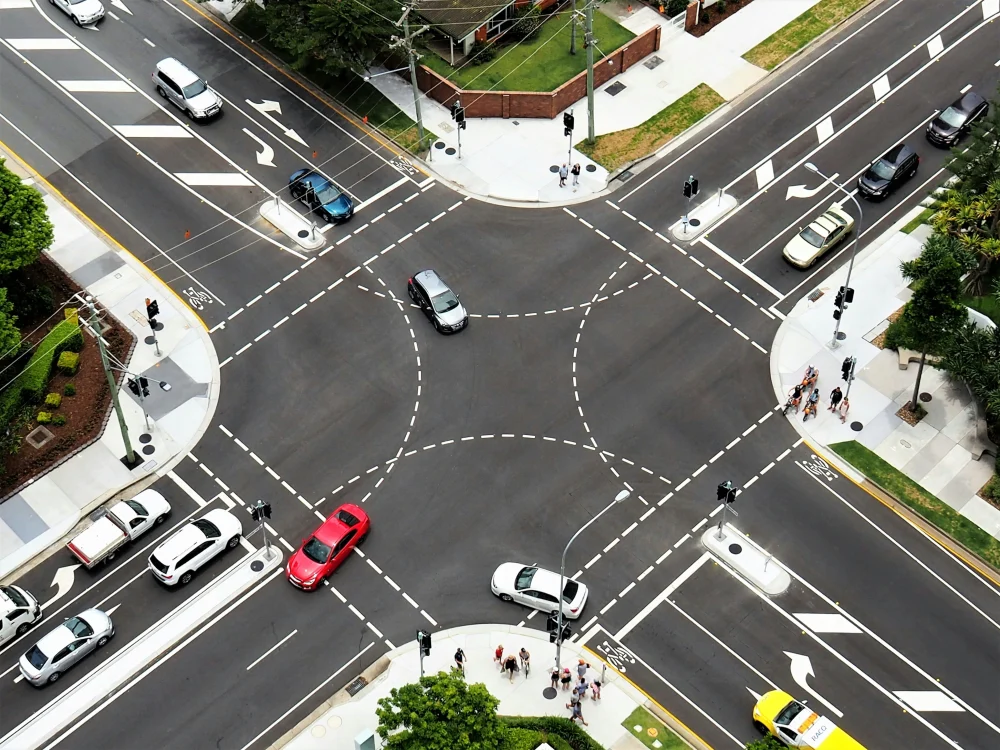
Upload footage from a single camera, a fixed survey site, or a temporary deployment, and the platform returns a structured picture of how the location actually behaves.
Conflict hotspots are mapped directly onto the scene, so you can see exactly where on the road the risk concentrates rather than reading it off a table. Road users are classified by type, separating cars, heavy vehicles, buses, motorcycles, cyclists, and pedestrians. This matters because risk is not evenly distributed: a conflict involving a pedestrian carries a very different weight from one between two cars.
Vulnerable road user interactions are surfaced specifically. Pedestrians and cyclists account for a disproportionate share of serious harm, and the platform treats their conflicts as a first-class output rather than a footnote.
Movement and turning patterns show how traffic flows through the site, which movements generate the most conflict, and where design or signal timing is working against safe behaviour.
Where it is used
Intersection safety audits. Assess a junction's real-world risk in days, using observed conflict data instead of waiting on a multi-year crash record. Before-and-after studies. Quantify whether a countermeasure actually worked. Measure conflicts before an intervention, deploy the change, then measure again and report the difference with evidence rather than intuition.
Vulnerable road user safety. Evaluate crossings, shared zones, school zones, and active-transport routes specifically for pedestrian and cyclist risk.
Black spot prioritisation. Rank multiple sites by observed conflict severity so limited budgets go to the locations that need them most, including sites that crash data has not yet flagged.
New and changed layouts. Validate the safety performance of a recently built or modified site long before enough time has passed to judge it on crashes.
Speed and behaviour studies. Capture real operating speeds and conflict patterns to support speed management decisions and design reviews.
Why it works for traffic professionals
The output is defensible. Every conflict, speed, and classification traces back to a specific moment in the footage you uploaded, so findings can be reviewed, audited, and stood behind in a report or a council meeting.
The turnaround is fast. What once took years of crash accumulation now takes the length of a survey plus processing time, which means safety decisions keep pace with project timelines.
The coverage is complete. Because the analysis works on any site with a usable camera view, you are no longer limited to locations with rich crash histories. New sites, low-volume sites, and recently changed sites are all analysable from day one.
The framing fits the mission. Surrogate safety analysis is built for the proactive, harm-prevention logic of the Safe System and Vision Zero. It gives you a way to find and fix risk before it becomes a casualty record.
From footage to findings
Capture video at the site you want to assess. Upload it to the platform. The analysis runs automatically, extracting conflicts, classifying road users, and mapping risk across the scene. You review the results, export what you need, and move straight to recommendations.
No manual frame-by-frame review. No multi-year wait. No reliance on harm that has already happened.
 Back to Solutions